
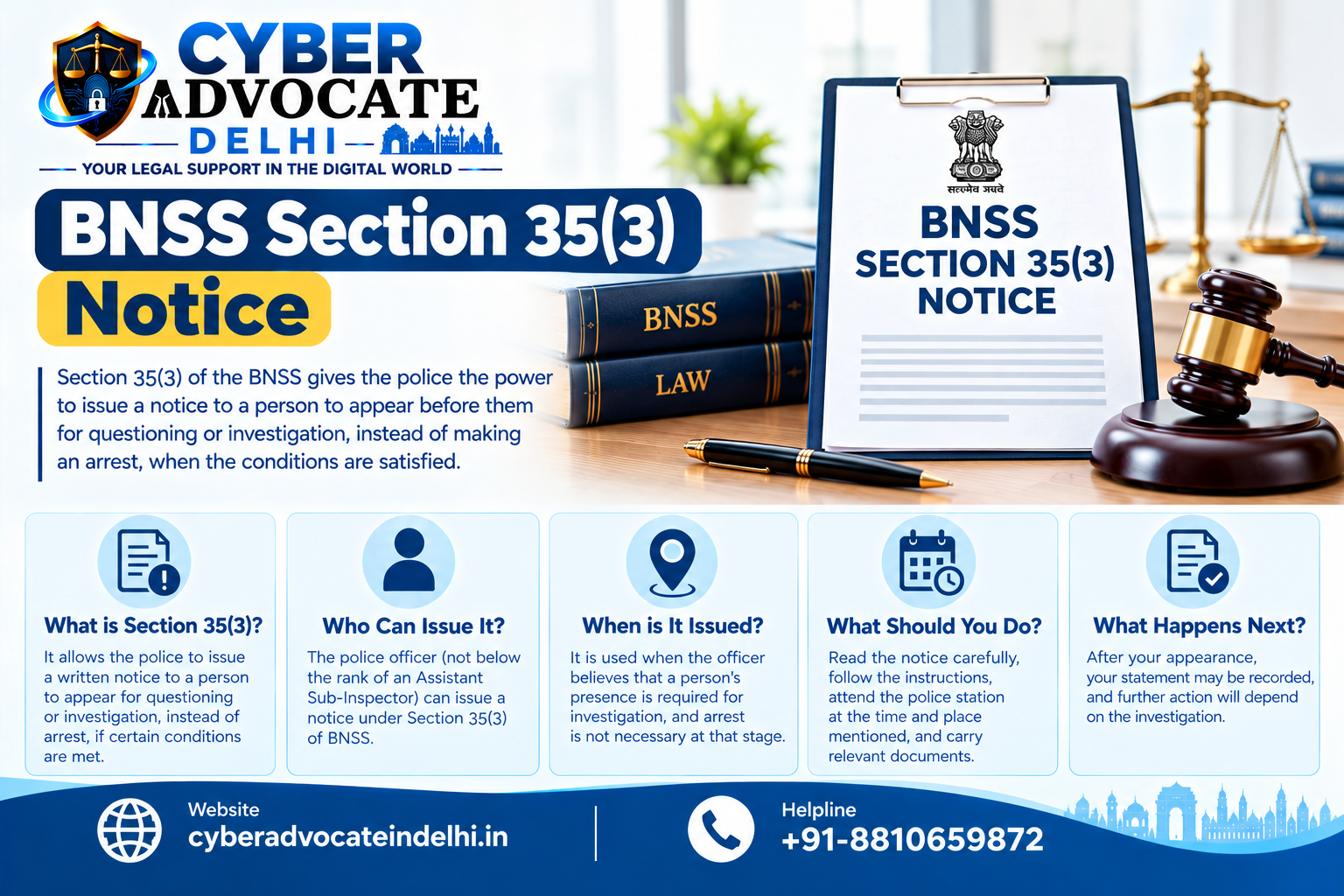
BNSS Section 35(3) Notice – Meaning, Rights & Legal Process
Getting a police notice at home, at the office, or even through email or another communication channel can immediately create anxiety. The situation becomes more confusing when the notice refers to Section 35(3) of the Bharatiya Nagarik Suraksha Sanhita, 2023 (BNSS). Many people see the word “police” and assume that an arrest is about to take place. Others are unsure whether they should go to the police station, send a reply, take documents, or speak to a lawyer first.
A BNSS Section 35(3) Notice is essentially connected with a police investigation and a requirement to appear before the investigating officer. The statutory form itself describes it as a “Notice for Appearance by the Police” and states that the investigating officer has reasonable grounds to question the person for ascertaining facts and circumstances relating to the investigation.
That distinction matters. A notice is not the same thing as a conviction, and it should not be read in isolation from the case in which it has been issued. For someone receiving such a notice for the first time, taking advice from a Criminal Lawyer, Criminal Advocate, or BNSS Lawyer before responding can help in understanding what the investigating agency is actually asking.
Why does the police send a Section 35(3) notice?
The answer is usually found in the investigation itself.
The police may be looking into a particular complaint or FIR and come across a person’s name, phone number, bank account, business transaction, communication, document or other information. They may then want to question that person and record information relevant to the case.
For example, imagine that an online fraud complaint has been registered and the investigation shows that money moved through several accounts. The owner of one of those accounts may receive a notice even though the person says they did not participate in the fraud. The investigating officer may want to know who sent the money, why it was received, whether the account holder knew the sender, and what happened to the amount afterwards.
The same thing can happen in disputes involving online purchases, UPI payments, social-media accounts, digital communications, business payments or identity-related issues.
This is particularly common in matters that involve technology and financial transactions. A Cyber Crime Lawyer or Cyber Crime Advocate dealing with such a matter may need to look beyond the notice itself and examine the transaction trail and surrounding circumstances.
The notice does not tell the whole story
One mistake people often make is reading only the section number.
The more useful information is usually elsewhere in the document. The notice may identify the FIR or case number, the police station, the provisions involved, the investigating officer and the date and time at which the person has been asked to appear.
The official form under Section 35(3) itself contains fields for these details.
So, before deciding what to do, read the entire notice.
If the notice refers to a case you have never heard about, that is something to clarify. If it concerns a transaction you recognise, collect the records relating to that transaction. If the allegations appear serious or the facts are unclear, getting the document reviewed by a Criminal Lawyer in Delhi or another appropriate lawyer may be sensible before you appear.
Does Section 35(3) mean that you are being arrested?
Not by itself.
Section 35 deals with the circumstances in which police may arrest without a warrant, while sub-section (3) provides for a notice requiring appearance where the circumstances described in the provision apply. The official form makes the purpose of the notice clear: the person is being directed to appear before the police officer so that facts and circumstances connected with the investigation can be ascertained.
That does not mean that a person should assume there can never be any further action. The entire provision has to be considered, along with the facts of the particular investigation.
In practical terms, the right approach is neither to panic nor to ignore the notice.
What should you do after receiving it?
Start with the basics.
Keep a copy of the notice. Check the case number and the police station mentioned in it. Note the date and time of appearance. Identify the officer who has issued it and read the allegations or sections referred to in the document.
Then think about your connection with the matter.
If it relates to a bank account, obtain the relevant bank statement and transaction details. If it concerns a business payment, keep the invoice, agreement, correspondence or other records that explain the transaction. If it involves a cyber complaint, preserve the relevant emails, chats, payment records, screenshots and other digital material.
Do not alter or delete digital records simply because you have received a notice. Trying to “clean up” information after learning about an investigation can create a much more serious situation.
Where the matter is complicated, a Cyber Law Lawyer, Cyber Attorney, or IT & Cyber Law Advocate can examine the notice together with the available records and help identify what actually needs to be addressed.
A written reply is not always the first step
There is a tendency to search online for a “Section 35(3) Notice Reply Format” and send a ready-made letter.
That is not always a good idea.
A reply should be based on the actual case. A person receiving a notice in a bank-fraud investigation may need to explain a transaction. Someone called in relation to a social-media complaint may have an entirely different set of facts. A business owner may have invoices and agreements that explain the disputed payment.
Copying a generic reply can leave out important facts or, worse, introduce statements that do not accurately describe what happened.
Sometimes the appropriate step is simply to appear and cooperate with the investigation. In another case, a written representation may be useful. There is no single reply that fits every Section 35(3) notice.
What happens at the police station?
That depends on the investigation.
The investigating officer may ask questions about the complaint, people involved, transactions, communications, documents or other facts. The questions can be straightforward or may cover a series of events that took place over a longer period.
This is where preparation makes a difference.
If you do not remember something, do not invent an answer. If you do not understand a question, ask for clarification. If a document is placed before you, read it carefully before signing anything.
In a cyber crime investigation, questions can also relate to devices, online accounts, IP-related information, payment platforms, email communications or other digital evidence. A person who is unfamiliar with the technical side of the matter may find the process difficult to follow without legal assistance.
What if the notice concerns a frozen bank account?
This is another situation in which people often become confused.
Suppose a bank account has been restricted because a disputed amount was traced through it. The account holder may receive a police notice asking questions about a particular payment. The fact that money passed through the account does not, by itself, explain the entire story.
The investigation may need to establish whether the account holder knew about the transaction, whether the account was being used by someone else, whether the payment was connected with a genuine sale or service, or whether there was some other explanation.
In such cases, the actual transaction history becomes important.
Bank statements, UPI references, invoices, messages and other supporting records can help explain the movement of money. A Cyber Crime Advocate may examine these records along with the complaint rather than treating the notice as a standalone document.
Can you ask for another date?
There can be situations in which a person genuinely cannot appear on the date mentioned in the notice.
The sensible course is not to simply disappear or ignore the communication. The reason for non-appearance should be properly communicated and an appropriate alternative may be requested, depending on the circumstances.
Whether such a request is accepted is a matter for the investigating agency and the facts of the case. If the matter is urgent or the notice carries serious allegations, legal advice should be taken rather than assuming that missing the date will have no consequences.
What role can a lawyer play?
A lawyer’s role is not simply to prepare a reply.
Before the person appears, a BNSS Advocate or Criminal Lawyer can read the notice, understand the FIR or complaint where available, identify the allegations and discuss the documents that may be relevant.
In a cyber-related matter, the review can become more detailed because the underlying evidence may include digital transactions, online accounts, electronic communications and device-related information.
The lawyer may also explain what the notice actually requires and what issues should be kept in mind while responding to questions.
That preparation is often more useful than downloading a standard reply format from the internet.
One thing you should not do
Do not ignore the notice simply because you believe the allegation is false.
If you genuinely have nothing to do with the alleged offence, that fact should be properly placed before the investigating agency with whatever material supports your position. An investigation is the stage at which facts are being collected and examined.
At the same time, do not assume that every police communication requires an immediate written admission or an emotional explanation.
Stay with the facts.
If the matter concerns a payment, explain the payment. If it concerns a person, explain the relationship. If it concerns a document, produce the relevant record where appropriate. If something is not within your knowledge, do not guess.
When professional advice becomes particularly important
Not every Section 35(3) notice requires the same level of preparation.
The situation deserves closer attention when the notice concerns allegations of cyber fraud, cheating, financial offences, identity misuse, multiple transactions, disputed digital evidence or a case involving several accused persons.
It is also worth getting advice when the person is worried about possible arrest or does not understand why their name or account has appeared in the investigation.
A Criminal Advocate, BNSS Lawyer, or Cyber Crime Lawyer can then assess the actual circumstances rather than relying only on the wording of the notice.
A BNSS Section 35(3) Notice is a serious document, but receiving one does not mean that a court has already decided that the person has committed an offence. The official BNSS form describes the notice as a direction to appear before the police during an investigation so that relevant facts and circumstances can be ascertained.
The safest approach is practical: read the notice properly, understand the case behind it, preserve relevant records and respond to the investigating agency in an informed manner. If the matter involves cyber crime, financial transactions or complicated allegations, taking advice from a Cyber Crime Lawyer, Criminal Lawyer, or BNSS Advocate before appearing can help you understand the situation and prepare accordingly.
Legal Disclaimer: This article is provided only for educational and informational purposes. It is not an advertisement or solicitation and does not create an advocate-client relationship.