
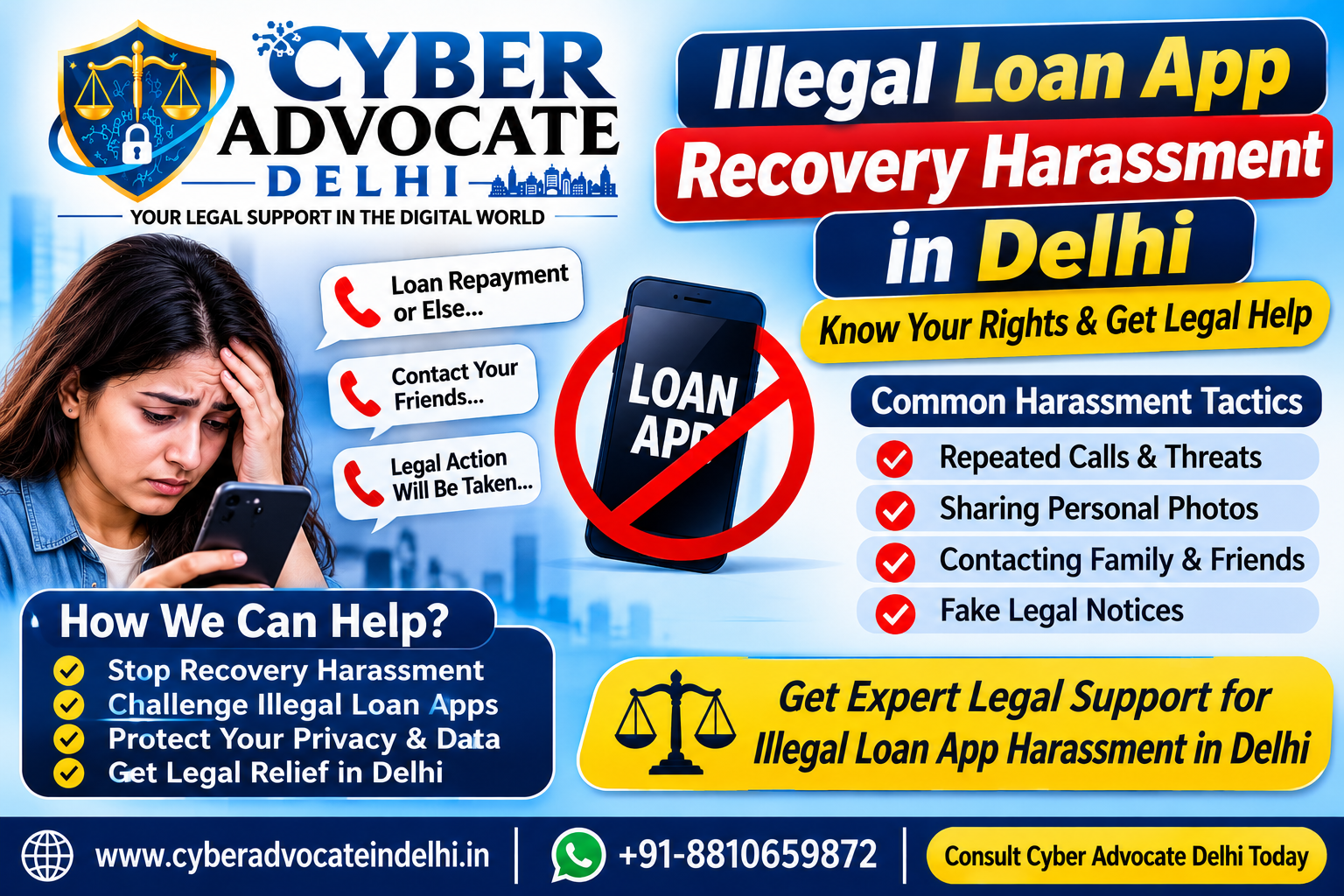
Facing illegal loan app recovery harassment in Delhi? Learn complaint procedures, RBI guidelines, cybercrime reporting and legal remedies.
Taking an instant loan through a mobile application may look like an easy way to manage an urgent financial requirement. However, problems begin when certain loan applications or their recovery agents start using threatening calls, abusive messages, blackmail and misuse of personal information to demand repayment.
Many borrowers in Delhi have concerns about illegal loan app recovery harassment, especially when recovery agents contact their family members, friends or office colleagues. In some cases, borrowers are threatened with edited photographs, public humiliation or false police complaints if they fail to pay the demanded amount.
It is important to understand that a borrower may have a genuine responsibility to repay a loan, but this does not give a recovery agent permission to threaten, abuse or publicly humiliate that person.
If you are facing loan app harassment in Delhi, you can take appropriate legal steps against unlawful recovery practices. This blog explains the complaint process, RBI guidelines, applicable legal provisions and the role of an Advocate in dealing with such matters.
What Is Illegal Loan App Recovery Harassment?
Illegal loan app recovery harassment refers to threatening, abusive or unlawful methods used by certain digital lending applications, lenders or recovery agents to collect outstanding loan amounts.
A genuine lender can contact a borrower regarding pending payments and follow lawful recovery procedures. However, problems arise when recovery agents cross legal boundaries to put pressure on borrowers.
Common examples of digital loan app harassment include:
- Repeated threatening calls and abusive WhatsApp messages.
- Contacting relatives and friends to disclose loan information.
- Threatening to circulate personal photographs.
- Misusing contact lists and private information.
- Demanding undisclosed interest, penalties or additional charges.
- Threatening arrest without a lawful basis.
- Sending fake police notices or legal documents.
- Blackmailing borrowers through social media.
- Threatening to damage the borrower’s reputation.
These activities may involve criminal offences, regulatory violations or privacy-related issues depending on the circumstances.
How Do Illegal Loan Apps Harass Borrowers?
Understanding common recovery tactics can help borrowers identify unlawful activities and collect relevant evidence.
1. Threatening Calls and Abusive Messages
Some recovery agents repeatedly call borrowers and use insulting or threatening language. They may threaten to visit the borrower’s home, contact their employer or initiate immediate police action.
Borrowers should request proper identification, the name of the actual lender and a written statement of the outstanding amount.
2. Contacting Family Members and Office Colleagues
One common form of loan recovery harassment involves contacting people saved in the borrower’s mobile phone.
Recovery agents may disclose personal loan information to relatives, friends or colleagues to create embarrassment and pressure.
The RBI has specifically prohibited regulated entities and their recovery agents from intimidating borrowers, humiliating them publicly or intruding into the privacy of their family members and friends. RBI+1
3. Photo Misuse and Online Blackmail
In some cases, loan applications or their agents threaten to circulate edited photographs or private information unless the borrower makes immediate payment.
Such threats should be taken seriously. Preserve screenshots, phone numbers, messages and other available digital evidence before reporting the incident.
4. Hidden Charges and Excessive Repayment Demands
Certain suspicious applications advertise small instant loans but later demand significantly higher amounts through unclear processing fees, penalties or additional charges.
Borrowers should check the loan agreement, Key Fact Statement (KFS), applicable interest rate and repayment schedule before accepting the demand.
What Does RBI Say About Digital Loan App Harassment?
The Reserve Bank of India has introduced regulatory requirements to improve transparency and borrower protection in digital lending.
The Reserve Bank of India (Digital Lending) Directions, 2025, issued on 8 May 2025, cover regulated lenders and their arrangements with Lending Service Providers (LSPs). These directions address loan disclosures, grievance redressal, data collection and customer protection. RBI+1
Important protections include:
- Digital lending applications should collect personal information only when necessary and with appropriate consent.
- Regulated lenders must ensure that their digital lending applications do not access mobile resources such as contact lists and call logs.
- Borrowers should have options to manage consent and certain data-sharing permissions.
- Applicable loan terms and charges must be properly disclosed.
- Regulated lenders must provide a grievance redressal mechanism.
The RBI also makes regulated lenders responsible for the conduct of their outsourced service providers, including recovery agents. Therefore, outsourcing recovery activities does not automatically remove the lender’s responsibility. RBI+1
How to File a Complaint Against Illegal Loan Apps in Delhi
If you are facing illegal loan app recovery harassment in Delhi, follow these steps to create a proper complaint record.
Step 1: Collect and Preserve Digital Evidence
Before uninstalling the suspicious application, save all available information.
Keep the following evidence:
- Screenshots of threatening messages.
- WhatsApp conversations and call logs.
- Phone numbers of recovery agents.
- Loan agreements and repayment records.
- Bank statements and UPI transaction details.
- Screenshots showing photo misuse or blackmail.
- Messages sent to family members or colleagues.
Preserve original electronic records wherever possible. Avoid editing or deleting important evidence.
Step 2: File a Cyber Crime Complaint
If the incident involves online blackmail, threats, impersonation, unauthorised data misuse or financial cyber fraud, report it through the National Cyber Crime Reporting Portal.
Official website: https://cybercrime.gov.in/
For immediate financial cyber fraud involving unauthorised transactions, call 1930 without delay.
Step 3: Submit a Complaint to Delhi Police
You can approach the concerned Cyber Police Station or local police station in Delhi, depending on the nature of the incident.
Your written complaint should mention:
- Name of the loan application.
- Name of the lender, if known.
- Loan amount and disbursement date.
- Amount already repaid.
- Additional repayment demands.
- Details of threatening calls and messages.
- Whether personal photographs or contact details were misused.
Attach supporting evidence and request appropriate investigation and legal action.
Step 4: Complain to the Concerned Bank or NBFC
Identify the actual lender associated with the digital lending application. Submit a written complaint to its grievance redressal officer.
Explain the recovery agent’s conduct and request an investigation. Keep the complaint acknowledgement for future reference.
Step 5: Approach the RBI Ombudsman, If Eligible
If your complaint concerns an RBI-regulated entity and remains unresolved, you may approach the RBI’s grievance redressal mechanism.
Under the applicable RBI framework, a complaint can generally be escalated if the regulated entity rejects it or does not provide a satisfactory response within 30 days.
Official portal: https://cms.rbi.org.in/. Reserve Bank of India+1
Legal Remedies Against Illegal Loan App Recovery Harassment
Depending on the evidence and nature of the incident, victims may have several legal remedies.
1. Criminal intimidation under Section 351 of BNS
If recovery agents threaten injury to a person’s body, reputation or property to cause fear or force an action, Section 351 of the Bharatiya Nyaya Sanhita, 2023, may be relevant.
2. Action for extortion and other criminal offences
Where threats are used to dishonestly obtain money or property, provisions relating to extortion and other applicable offences may be examined by the police.
3. Action for cybercrime and identity misuse
If photographs, accounts or personal information are misused, relevant provisions of the Information Technology Act, 2000, and other applicable laws may be considered depending on the conduct.
4. Action for privacy and data-related violations
Unauthorised collection, access or sharing of personal information may raise issues under applicable data-protection laws and RBI digital lending directions.
5. Legal notice and appropriate court proceedings
An Advocate may examine the facts and advise whether a legal notice, criminal complaint or suitable court proceedings are appropriate.
These remedies are fact-specific. A genuine repayment dispute should be distinguished from separate unlawful recovery conduct.
What Is the Role of an Advocate in Loan App Harassment Cases?
An Advocate for illegal loan app harassment in Delhi can help borrowers understand their rights and take appropriate legal steps.
The Advocate may assist with:
- Examining loan agreements and repayment demands.
- Identifying possible RBI regulatory violations.
- Preparing a detailed cybercrime complaint.
- Organising digital evidence.
- Filing complaints before the appropriate police authorities.
- Issuing legal notices to concerned lenders or recovery agencies.
- Assisting with RBI grievance procedures where applicable.
- Advising on criminal and civil remedies.
- Representing clients in appropriate legal proceedings.
The purpose of legal assistance is to address unlawful recovery practices while distinguishing them from the borrower’s genuine repayment obligations.
Frequently Asked Questions (FAQs)
1. Can I file a complaint against an illegal loan app in Delhi?
Yes. You can approach Delhi Police or report the incident through the National Cyber Crime Reporting Portal if the application or its agents are involved in threats, blackmail or misuse of personal information.
2. Can loan recovery agents contact my family members?
Regulated lenders and their recovery agents must follow RBI recovery guidelines. Intimidating family members, disclosing private information to humiliate borrowers and intruding into their privacy are prohibited practices.
3. What should I do if a loan app threatens to send my photos to others?
Save the threatening messages, preserve the relevant digital evidence and report the matter to the cybercrime authorities. Seek legal advice regarding appropriate action for blackmail and privacy violations.
4. Can I take legal action against loan recovery agents?
Yes. If recovery agents use threats, intimidation, blackmail or other unlawful methods, you can approach the police and pursue appropriate legal remedies.
5. Can police arrest someone for not repaying an instant loan?
Failure to repay a genuine loan does not automatically amount to a criminal offence. However, separate allegations of fraud or other criminal activity must be examined according to the facts.
6. Can an Advocate help stop loan app harassment?
An Advocate can prepare complaints, examine evidence, issue legal notices, assist with regulatory grievances and advise on appropriate legal proceedings.
Get Legal Assistance for Loan App Harassment in Delhi
Threatening calls, online blackmail, photo misuse and abusive recovery practices should not be treated as normal loan recovery procedures.
If you are facing illegal loan app recovery harassment in Delhi, timely legal assistance can help you document the incident, identify the responsible parties and pursue appropriate remedies under applicable laws.
For legal assistance regarding cybercrime complaints, digital loan harassment and unlawful recovery practices, visit:
Website: https://cyberadvocateindelhi.in/
Helpline: +91-8810659872
Disclaimer: This content is for educational and informational purposes only. It is not an advertisement or solicitation and does not create an advocate-client relationship.
