
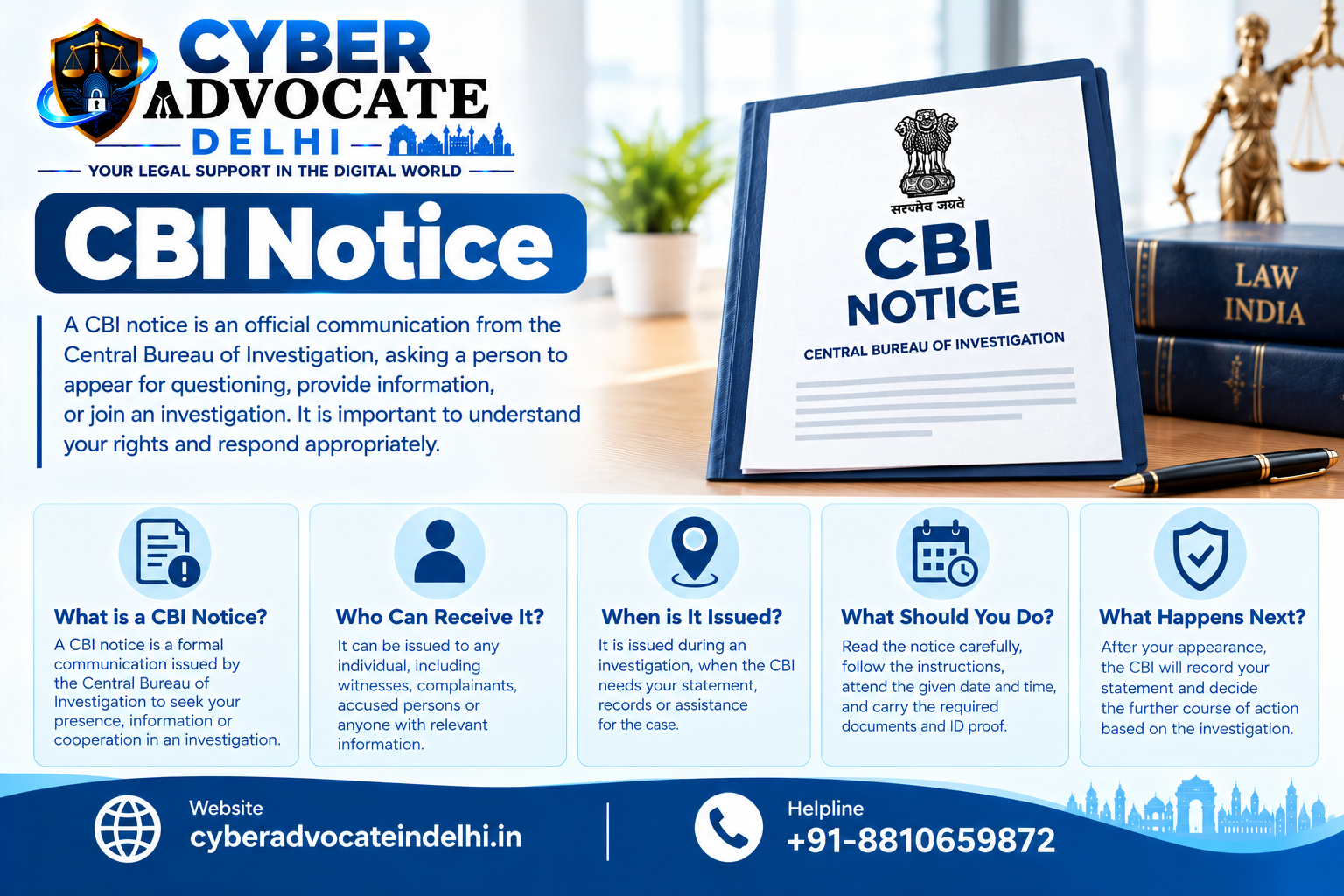
CBI Notice – Understanding the Investigation Notice
Receiving a CBI Notice can naturally make a person concerned. A notice from the Central Bureau of Investigation may relate to an ongoing inquiry, investigation, documents, financial transactions, business dealings, electronic records or information connected with another person or organisation. The first reaction is often to assume that a criminal case has already been proved against them, but that is not necessarily the correct way to understand such a notice.
If you have received a CBI communication, speaking with a CBI Lawyer or CBI Advocate can help you understand what the notice is asking for before you decide how to respond. In matters involving allegations of fraud, corruption, financial irregularities, digital evidence or other serious offences, a Criminal Lawyer can review the notice along with the available documents and explain the legal position.
A Legal Advocate may also help when the notice requires personal appearance, production of documents or clarification about a particular transaction or event. The important point is to read the notice carefully instead of preparing a hurried response based only on assumptions.
What Is a CBI Notice?
A CBI Notice is a formal communication issued in connection with a matter being examined or investigated by the Central Bureau of Investigation. The exact purpose can differ from one case to another.
A person may be contacted because the investigating agency requires information, documents, clarification or the person’s statement in relation to a particular matter. In some cases, the individual may be directly connected with the allegations. In others, the person may simply have information or records that could be relevant to the investigation.
This distinction matters.
Receiving a CBI Investigation Notice does not automatically mean that the person receiving it has been declared guilty of an offence. The contents of the notice, the case background and the person’s connection with the matter have to be understood before reaching any conclusion.
Why Does CBI Send an Investigation Notice?
Investigations can involve several individuals, companies, financial transactions and documents. An investigating agency may therefore need information from people who are not necessarily the main accused.
For example, a person may have conducted a business transaction with someone under investigation. A company employee may have handled particular records. A bank or financial institution may have information about a transaction. Similarly, a person may possess emails, invoices, agreements, account statements or other documents relevant to the investigation.
In such circumstances, a CBI Notice for Investigation may be issued to obtain the required information or to require the person’s appearance.
The actual reason should always be determined from the notice itself rather than from assumptions made after receiving it.
Does a CBI Notice Mean an FIR Has Been Registered?
Not every notice should be treated as proof that an FIR has already been registered against the recipient.
An investigation may involve different stages and different types of communication. A person could be contacted for information or clarification, while another person involved in the same matter may have a different legal status.
This is why the wording of the notice is important. Check whether it refers to a case number, inquiry, investigation, complaint, particular offence, documents or a specific transaction.
If the language of the notice is unclear, getting it reviewed by a CBI Lawyer in Delhi or another appropriate criminal law professional can help in understanding what is actually being asked.
What Should You Check in a CBI Notice?
Do not read only the date and appearance instructions.
Go through the entire document carefully. Check the issuing authority, reference or case details, date, place of appearance, information requested and documents that you have been asked to produce.
Also look at whether the notice asks you to appear personally or to provide particular records.
If the notice relates to a company, bank account, property transaction, contract or financial dealing, collect the related records before deciding what information needs to be provided.
A proper response starts with understanding the question being asked.
How Should You Respond to a CBI Notice?
There is no universal reply that can be used for every CBI Notice Reply.
The response should be based on the contents of the notice and the actual facts. If documents have been requested, they should be checked before submission. If clarification has been sought about a particular transaction, the explanation should be accurate and supported by available records wherever possible.
Avoid giving unnecessary explanations about matters that have not been asked about.
At the same time, do not leave important questions unanswered simply because you are worried about the investigation.
Where the matter is legally complicated, a CBI Advocate can review the notice and help in preparing a response that addresses the relevant points without adding unnecessary or inaccurate information.
What Documents May Be Relevant?
The documents required will depend on the subject of the investigation.
A notice may relate to financial transactions, employment records, business agreements, invoices, correspondence, bank statements, property documents, company records or electronic communications.
If the investigation involves digital material, emails, messages, files and other electronic records may also become relevant.
It is better to preserve the original records rather than modifying or deleting them after receiving the notice.
If there are multiple documents, arrange them chronologically. This makes it easier to understand the sequence of events and identify which documents actually relate to the matter.
CBI Notice Related to Financial Transactions
Financial matters can become complicated because one transaction may involve several people, accounts and documents.
Suppose a person received money from a company and that transaction later became part of an investigation. The relevant question may not simply be whether money was received. The background of the transaction, reason for payment, agreement between the parties, invoices and subsequent use of the funds may also matter.
A CBI Investigation Notice concerning financial records should therefore be examined carefully.
A CBI Lawyer may review the transaction history and supporting documents before a detailed response is prepared. This can be particularly relevant where allegations involve fraud, financial irregularities, cheating, corruption or misuse of funds.
What If the Notice Requires Personal Appearance?
Some notices may require the recipient to appear before the investigating officer.
Do not assume that a personal appearance requirement can simply be ignored. At the same time, do not attend without first understanding what the notice concerns, particularly when the matter involves serious allegations.
The notice should be checked for the date, time and place of appearance.
If there is a genuine difficulty in appearing on the specified date, the circumstances should be considered carefully and, where appropriate, a request for another date may be made through the proper channel.
Whether such a request is appropriate depends on the wording of the notice and the circumstances involved.
Can a Lawyer Accompany You?
Whether and to what extent a lawyer can be present during an interaction with investigating authorities depends on the circumstances and applicable legal procedure.
This is one reason why a person facing a serious investigation should understand their legal position before appearing.
A Criminal Advocate or CBI Lawyer can explain the nature of the proceedings, review the notice and advise on preparation for the interaction.
The purpose is not to avoid a lawful investigation. It is to ensure that the person understands the process and responds appropriately.
What Should You Avoid After Receiving a CBI Notice?
The first mistake is ignoring the communication.
Another common problem is deleting messages, changing records or destroying documents because the recipient becomes worried about the investigation. Such conduct can create additional complications.
Avoid submitting fabricated documents or making statements that are not factually correct.
It is also not advisable to copy a generic CBI Notice Reply from the internet and submit it without checking whether it actually relates to your circumstances.
Every investigation has its own background. A response should therefore be prepared from the actual notice and available records.
Can a CBI Notice Be Challenged?
The legal remedy available against a particular notice depends on its nature, the stage of investigation, the authority issuing it and the circumstances of the case.
There is no single remedy that applies to every CBI communication.
If a person believes that the notice has been issued improperly or that there is a specific legal issue with the manner in which the proceedings are being conducted, the notice should be examined by an appropriate CBI Advocate or Criminal Lawyer.
The possible legal course can then be considered based on the documents and facts.
What Happens After a CBI Notice Reply?
Submitting a reply does not necessarily mean that the investigation ends immediately.
The investigating agency may examine the response, verify the documents and seek further information if required. Additional communication may follow depending on the progress of the investigation.
For this reason, keep a copy of the notice, reply and all documents submitted.
If the matter continues, maintaining a proper record can make it easier to understand what information has already been provided.
When Should You Consult a CBI Lawyer?
Legal advice becomes particularly important where a CBI Notice involves serious allegations, financial transactions, company records, corruption-related allegations, fraud, property matters, digital evidence or a requirement of personal appearance.
A CBI Lawyer in Delhi, Criminal Lawyer, CBI Advocate or Criminal Law Advocate can review the communication and explain the appropriate legal approach based on the circumstances.
The earlier the notice is properly understood, the easier it can be to organise the relevant documents and prepare an appropriate response.
Frequently Asked Questions
Is receiving a CBI Notice the same as being accused?
Not necessarily. The purpose of the notice depends on its contents and the person’s connection with the investigation.
Should I ignore a CBI Notice?
Ignoring a formal investigation notice can create unnecessary complications. The notice should be read carefully and an appropriate response should be considered.
Can a CBI Lawyer help prepare a notice reply?
Yes. A CBI Lawyer can review the notice, examine relevant documents and assist in preparing a factual response where legal assistance is appropriate.
What documents should I keep after receiving a CBI Notice?
Keep the original notice, relevant correspondence, financial records, agreements, invoices and other documents connected with the subject of the investigation. Digital records should also be preserved where relevant.
Does every CBI Notice require a personal appearance?
Not necessarily. The requirement depends on what the particular notice asks the recipient to do.
A CBI Notice should neither be ignored nor treated as proof of guilt. The correct approach starts with reading the communication carefully and understanding why the investigating agency has contacted you.
If the notice concerns a financial transaction, company records, fraud allegation, corruption-related matter, property transaction or other serious issue, it is sensible to understand the legal position before responding.
A CBI Advocate, CBI Lawyer or Criminal Lawyer can review the notice and relevant records and explain the available legal approach according to the facts of the matter.
The safest approach is to remain factual, preserve original documents and respond to the specific requirements mentioned in the notice.
Legal Disclaimer: This content is provided only for educational and informational purposes. It is not an advertisement or solicitation and does not create an advocate-client relationship.