
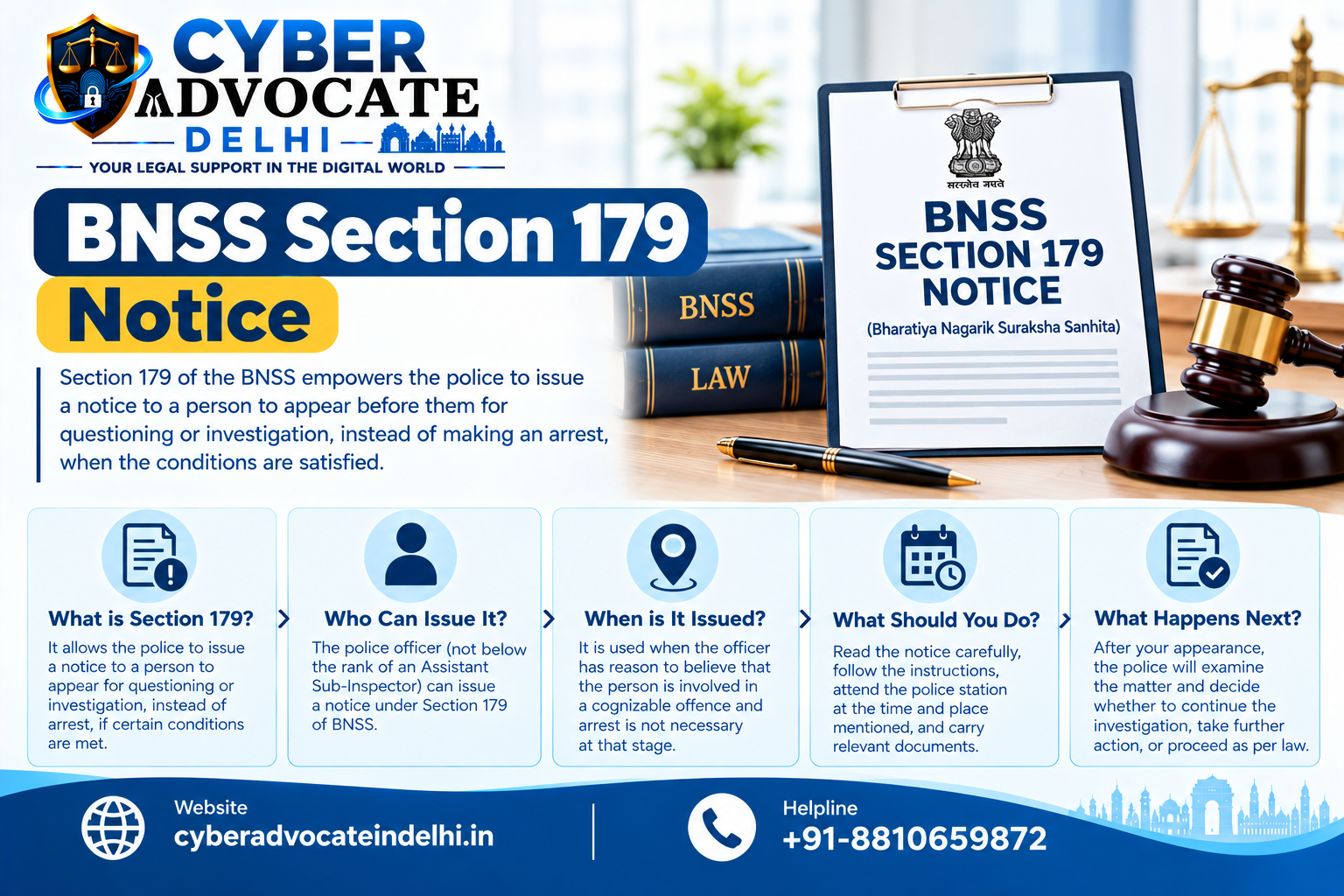
BNSS Section 179 Notice – Complete Legal Guide
A police notice under Section 179 of the Bharatiya Nagarik Suraksha Sanhita, 2023 (BNSS) can leave a person wondering why the police want them to appear and whether they are being treated as an accused. In many cases, the answer is quite different from what people initially assume.
Section 179 deals with the power of a police officer to require the attendance of witnesses during an investigation. It allows an investigating police officer, by an order in writing, to require a person who appears to be acquainted with the facts and circumstances of the case to attend before the officer. The provision has been in force since July 1, 2024, when the BNSS came into operation.
That means a BNSS Section 179 Notice is not the same type of notice as a Section 35(3) appearance notice. The distinction is important. Section 35(3) concerns appearance of a person in the circumstances specified under Section 35, whereas Section 179 specifically concerns the attendance of persons who may have information about the facts of an investigation.
For someone who has received such a notice, understanding this difference is the first step.
What Section 179 actually says
Section 179 is part of the chapter dealing with police investigation. It permits a police officer investigating a case to issue a written order requiring the attendance of a person who appears to be acquainted with the facts and circumstances of that case.
The person does not necessarily have to be the complainant or the accused. The provision is directed at witnesses and persons who may have relevant knowledge.
For example, suppose a cyber fraud investigation involves a disputed payment. The police may want to speak with the person who made the payment, received it, handled the transaction, communicated with the parties, or otherwise knows how the transaction took place. A person in that position may receive a Section 179 notice because their information could assist the investigation.
The same principle can apply in an ordinary criminal investigation. A neighbour who saw an incident, an employee who handled a relevant document, a person involved in a transaction, or someone who has direct knowledge of an event may be asked to attend.
So, simply receiving a Section 179 BNSS Notice should not automatically lead to the conclusion that the recipient has been accused of committing the offence.
Who can be asked to appear?
The wording of Section 179 focuses on a person who appears to be acquainted with the facts and circumstances of the case.
This gives the provision a practical purpose. Investigations often depend on information held by people who are not accused persons at all.
Consider a situation involving an online business transaction. The police may want to understand who placed an order, who processed the payment, who delivered the goods and what communications took place between the parties. Several people could potentially have relevant information even though only one person may ultimately face allegations.
A Criminal Lawyer or Criminal Advocate reviewing a Section 179 notice would therefore first want to understand the recipient’s connection with the investigation.
The notice should not be judged merely by the fact that it came from a police station. The surrounding facts matter.
Section 179 notice and cyber crime investigations
The provision can become particularly relevant in cases involving digital transactions.
Cyber crime investigations often involve several people whose details appear in electronic records. A bank account may have received money. A phone number may appear in a communication trail. An email account may be connected with a transaction. A person may have sold a product online without knowing that the buyer was involved in fraud.
The police may want information from such a person to understand the chain of events.
For instance, imagine that money connected with an online fraud reached an individual’s account. The account holder may be asked to explain why the payment was received, what relationship existed with the sender and what happened after the money arrived.
That does not, by itself, establish that the account holder participated in the alleged fraud.
This is where a Cyber Crime Lawyer or Cyber Crime Advocate may need to examine the actual transaction trail, messages, invoices, bank records and other material before the person appears.
A significant protection under Section 179
One of the most important parts of Section 179 is often overlooked.
The provision says that a male person under fifteen years of age or above sixty years of age, a woman, a mentally or physically disabled person, or a person suffering from acute illness should not be required to attend at a place other than the place where that person resides.
There is also a further provision stating that if such a person is willing to attend at the police station, the person may be permitted to do so.
This is not a minor procedural detail. It can make a real difference to someone who receives a notice and assumes that they must physically travel to the police station in every situation.
The exact circumstances should still be examined before deciding how to respond, particularly where the police communication does not clearly explain the nature of the investigation.
Does a Section 179 notice mean the person is an accused?
Not necessarily.
This is probably the most common misunderstanding surrounding the provision.
Section 179 is specifically titled “Police officer’s power to require attendance of witnesses.” Its purpose is to obtain information from persons who appear to know something about the case.
A person may therefore be called because they are a witness, because they have information about a transaction, or because the investigating officer believes they can clarify an important fact.
However, the exact legal position can depend on what the investigation reveals. A person should not assume that the label of “witness” permanently determines how the investigation will proceed.
If the allegations are serious or the person’s own conduct is being questioned, speaking with a Criminal Lawyer before appearing may be appropriate.
What should you check when you receive the notice?
Read the notice from beginning to end.
Look for the name of the police station, the case or FIR number if mentioned, the name and designation of the investigating officer, the date and time of appearance, and the reason or context in which your attendance has been requested.
Then consider why the police may have your name.
If the matter concerns a bank transaction, keep the relevant transaction records. If it involves a business relationship, locate the agreements, invoices or correspondence that explain the dealings. If it concerns a cyber complaint, preserve emails, messages, payment records and other relevant digital material.
Do not delete or modify records after learning about an investigation. Digital evidence can become important later, and attempting to alter it can create unnecessary complications.
Do you have to take every document with you?
No fixed collection of documents applies to every Section 179 notice.
The useful documents depend on the subject of the investigation.
Someone called regarding a property transaction may need different records from someone being questioned about an online payment. A person connected with a business may have contracts and invoices, while a person involved in a cyber complaint may have emails, chat records, screenshots or payment confirmations.
It is usually better to organise the material that genuinely relates to the issue rather than arriving with a large collection of unrelated documents.
If you are uncertain about what the police are asking for, a BNSS Lawyer can review the notice and help you understand what information is relevant.
What happens when you appear before the police?
The investigating officer may ask questions about the incident or transaction under investigation.
The questions could be simple, or they may involve a sequence of events that happened over several days or months. You may be asked about another person, a document, a payment, a phone number, a meeting or an online communication.
The safest approach is to answer truthfully and stay within your actual knowledge.
If you do not remember something, do not guess. If you were not present at an event, say so. If you only know part of a transaction, explain that rather than filling the gaps with assumptions.
This is especially relevant in cyber crime cases because people sometimes receive questions about transactions or digital activity that they do not personally remember.
A Cyber Law Advocate may help explain the technical and legal background before the person attends.
What about statements made during investigation?
Section 179 should also be understood alongside the following provisions dealing with examination and statements of witnesses during police investigation. Section 180 deals with examination of witnesses by police, while Section 181 addresses statements made to police and their use.
This is one reason why a person should not treat a police inquiry as an informal conversation with no legal significance.
The circumstances in which a statement is made, what exactly is recorded, and how the law treats that material can matter later.
If the investigation has serious consequences for you personally, obtaining legal advice before making detailed statements may be sensible.
What if the notice concerns a bank account?
Bank-related investigations are increasingly common in cyber crime matters.
A person may receive a BNSS Section 179 Notice because their account appears somewhere in the transaction chain. The person may have received money from someone they know, sold something online, provided a service, or simply had an account through which a disputed payment passed.
The police may want to establish the actual reason for the transaction.
In such a situation, bank statements, UPI records, invoices, payment confirmations and relevant conversations can help explain the background.
The fact that an account appears in an investigation should not automatically be treated as proof of involvement in the alleged offence. The actual circumstances need to be examined.
Can the police ask a woman to come to the police station?
Section 179 contains a specific protection for women. It provides that a woman should not be required to attend at a place other than her residence under the circumstances covered by the provision. The same residence-based protection is stated for certain minors, persons above sixty, mentally or physically disabled persons and persons suffering from acute illness.
The provision also says that where such a person is willing to attend at the police station, they may be permitted to do so.
Therefore, a woman receiving a Section 179 notice should not simply assume that the notice necessarily requires physical attendance at a police station. The wording of the notice and the facts of the investigation should be examined.
What if you cannot attend?
There can be genuine reasons why a person cannot attend at the specified time.
Instead of ignoring the notice, communicate the difficulty through an appropriate channel and explain the reason. Where necessary, legal assistance can be taken to make the position clear to the investigating officer.
The response will depend on the circumstances. A person should not assume that simply missing the date has no consequences.
At the same time, a person who has received a notice under Section 179 should understand exactly what the notice requires before taking any step.
Can a lawyer help with a BNSS 179 notice?
Yes, particularly when the reason for the notice is unclear or the investigation involves serious allegations.
A Criminal Advocate can examine the notice and the surrounding facts. In a cyber matter, a Cyber Crime Lawyer may also look at the digital and financial records connected with the investigation.
The useful role of a lawyer is not necessarily to create a lengthy written reply. Often, the first task is much simpler: understand why the person has been called, what information may be relevant, and what the person’s legal position is before appearing.
That distinction is important because a generic BNSS 179 Notice Reply downloaded from the internet may have little connection with the actual facts of a particular investigation.
Do not confuse Section 179 with Section 35(3)
This distinction deserves special attention because the two provisions are frequently mixed up online.
Section 179 deals with the police requiring the attendance of persons who appear to be acquainted with the facts and circumstances of a case. Section 35(3), on the other hand, relates to a police notice requiring appearance in the circumstances specified under Section 35. The official BNSS Second Schedule separately provides a “Notice for Appearance by the Police” under Section 35(3).
So, if a document specifically mentions Section 179, it should not automatically be described as a “Section 35 notice.”
The legal context is different.
A practical way to deal with the notice
Do not panic when the notice arrives, but do not ignore it either.
First, preserve the original notice and make a copy. Next, understand the case or investigation referred to in it. Work out why your name or details may have appeared. Collect the records that genuinely relate to the matter.
If you are being called only because you have information about an incident, your position may be very different from someone whose own conduct is under investigation. If the notice concerns cyber fraud, financial transactions or disputed digital evidence, the distinction can become particularly important.
Where there is uncertainty, getting the notice reviewed by a BNSS Advocate, Criminal Lawyer, or Cyber Crime Advocate before appearing can help you understand the situation instead of relying on assumptions.
A BNSS Section 179 Notice is primarily connected with the police power to require the attendance of witnesses or other persons who appear to have knowledge of the facts and circumstances of an investigation. It does not automatically mean that the recipient is an accused or that the person has committed an offence. Section 179 also contains specific protections concerning where certain categories of persons can be required to attend.
The right response depends on the reason for the notice and the person’s connection with the investigation. Read the document carefully, preserve relevant records, understand your position and avoid giving speculative answers. Where the investigation involves serious criminal allegations, cyber fraud, financial transactions or sensitive digital evidence, professional legal advice can help a person approach the process with a clearer understanding of their rights and responsibilities.
Legal Disclaimer: This article is provided only for educational and informational purposes. It is not an advertisement or solicitation and does not create an advocate-client relationship.