
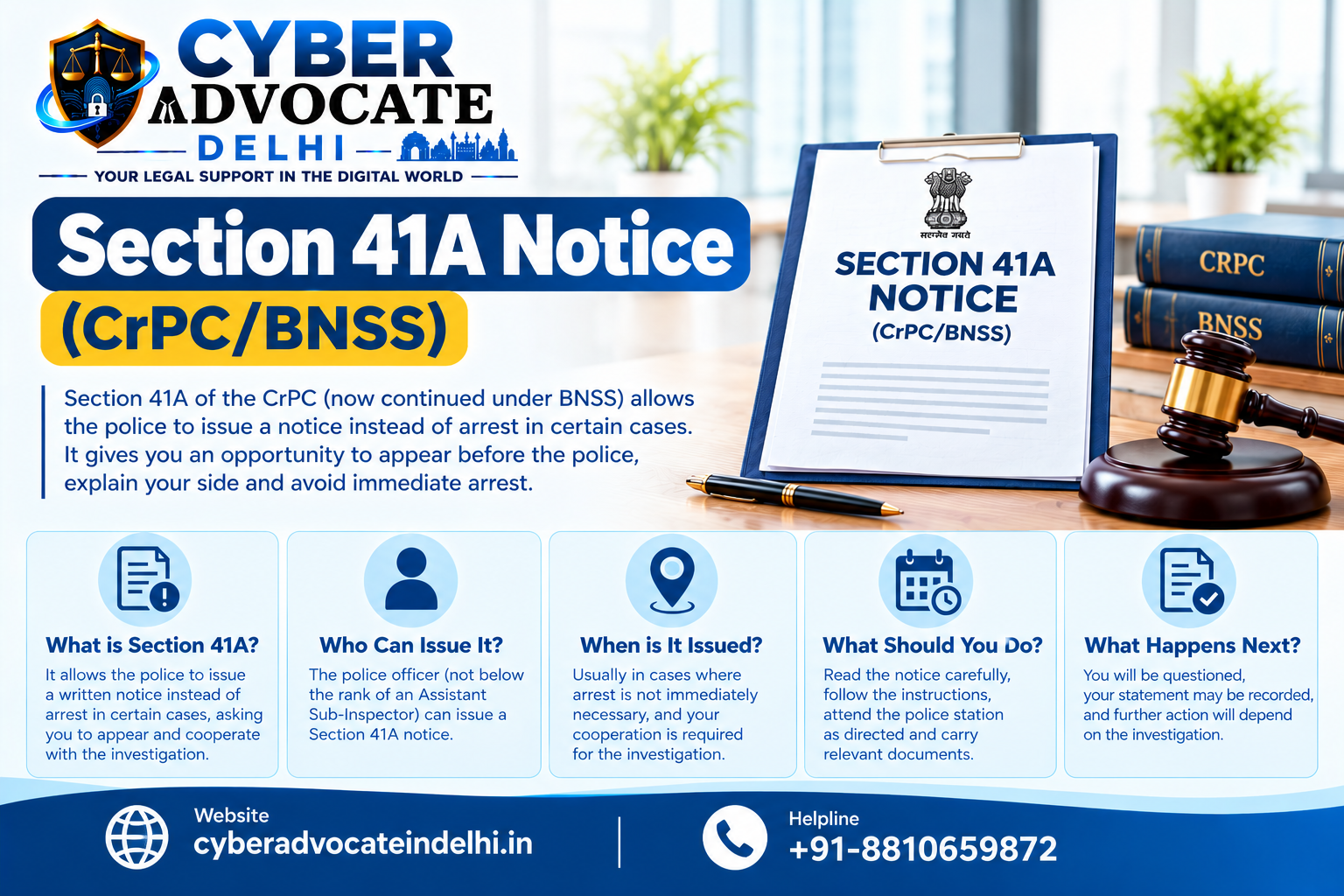
Section 41A Notice (CrPC/BNSS) – Everything You Need to Know
A Section 41A Notice is something many people come across when the police are investigating a criminal complaint or FIR but do not consider immediate arrest necessary. The notice can be confusing, especially because the law has changed after the introduction of the Bharatiya Nagarik Suraksha Sanhita, 2023 (BNSS).
Under the old Code of Criminal Procedure, 1973 (CrPC), Section 41A dealt with a “Notice of appearance before police officer.” The provision required the police officer, in the circumstances covered by Section 41A, to issue a notice directing the concerned person to appear before the officer or at another specified place.
Since the BNSS came into force on July 1, 2024, the corresponding provision is found in Section 35 of the BNSS. Section 35(3) provides for a notice requiring appearance before the police. The official BNSS form also separately describes this as a “Notice for Appearance by the Police.”
So, if someone today receives a document casually described as a “41A notice,” it is important to check the date of the proceeding and the actual provision mentioned in the document. In a current investigation, the notice may be issued under the BNSS rather than the repealed CrPC framework.
What was a Section 41A Notice under the CrPC?
Section 41A was introduced to deal with situations where the police had grounds to question a person regarding a cognizable offence, but arrest was not required under the circumstances specified by Section 41.
The idea was straightforward: instead of automatically taking a person into custody, the police could direct that person to appear before the investigating officer.
The wording of the old provision also placed a duty on the person receiving the notice to comply with its terms. If the person complied and continued to comply, the provision stated that arrest in respect of the offence mentioned in the notice should not ordinarily take place unless the police officer recorded reasons for considering arrest necessary. It also dealt with the consequences of failing to comply with the notice.
That is why a 41A Notice should never be treated as an ordinary invitation from the police. It was a formal part of the criminal investigation process.
What has changed under the BNSS?
The CrPC is no longer the general procedural law governing new criminal proceedings after the BNSS came into force.
The BNSS came into force on July 1, 2024, and its Section 35 deals with when police may arrest without a warrant. Section 35(3) provides for a notice requiring appearance where the statutory conditions for such notice are met.
The official BNSS Form No. 1 gives a useful indication of what this notice looks like. It refers to an FIR or case number, the police station, the relevant offences and the date, time and place at which the noticee is required to appear. It states that reasonable grounds exist to question the person to ascertain facts and circumstances relating to the investigation.
Therefore, in a present-day case, a person searching for “Section 41A notice” should also understand BNSS Section 35(3) Notice.
Does receiving a 41A or BNSS notice mean you are accused?
Not necessarily.
This is one of the biggest misunderstandings surrounding these notices.
The fact that the police want to question someone does not by itself establish guilt. The investigation may involve a complaint, a transaction, communication, business dealing or another event in which the person’s name or information has appeared.
For example, a person may receive a notice because their bank account appears in a disputed transaction. Someone may be asked about communications with another individual. A business owner may be questioned about a payment or document. In a cyber crime investigation, a phone number, email address, online account or payment record may bring someone into the investigation even when the person denies any involvement in the alleged offence.
That does not mean the notice can simply be ignored. It means the recipient should first understand why the police want their appearance and what exactly the investigation concerns.
Why might the police issue this type of notice?
The reason varies from case to case.
In a conventional criminal case, the police may want clarification about an incident, a person, a document or a transaction. In financial matters, the questions may relate to the movement of money or the relationship between the parties.
Cyber crime cases can be even more complicated.
Suppose an online fraud involves several bank accounts. During the investigation, the police discover that a particular account received money connected with the alleged fraud. The account holder may be asked to explain the transaction. The person may have a genuine explanation, such as a sale, repayment, business payment or another legitimate dealing.
A Cyber Crime Lawyer or Cyber Crime Advocate may therefore need to look at the complete transaction trail instead of judging the situation only from the fact that the account appears in the FIR or investigation.
What should you check when the notice arrives?
Before going anywhere, read the notice properly.
Look at the FIR or case number, police station, sections mentioned, name of the investigating officer, date and time of appearance and the place where you have been directed to attend.
Also check which law has actually been mentioned.
If the document refers to Section 41A CrPC, it may relate to an older proceeding or an earlier stage of a matter. If it refers to Section 35(3) BNSS, it is operating under the current criminal procedure framework.
That distinction is important because people sometimes use “41A notice” as a general term for every police appearance notice, even though the statutory provision has changed.
Should you go alone?
There is no single answer that applies to every case.
If the notice concerns a simple factual inquiry and you understand exactly why you have been called, the situation may be relatively straightforward.
But where the matter involves allegations of cheating, cyber fraud, financial offences, multiple accused persons, disputed transactions or other serious allegations, it may be sensible to speak with a Criminal Lawyer or Criminal Advocate before appearing.
The lawyer can review the notice and, where available, the FIR and relevant documents. That allows the person to understand the nature of the allegations instead of walking into the investigation without knowing what the police are investigating.
What should you take with you?
That depends entirely on the subject of the notice.
If the matter concerns a bank transaction, relevant bank statements, UPI records, payment confirmations or invoices may help explain what happened.
If it concerns a business transaction, agreements, correspondence and supporting documents may be relevant.
If it concerns a cyber crime complaint, emails, chats, screenshots, payment records and other digital material may become important.
Do not delete or alter information after receiving a police notice. Digital evidence can become an important part of a criminal investigation, and attempts to change records can create additional complications.
A Cyber Law Lawyer or IT & Cyber Law Advocate can help identify which records are actually relevant when the matter involves digital evidence.
Is a written reply necessary?
Not every notice requires the same kind of response.
Sometimes the immediate requirement is simply to appear before the investigating officer. In another case, a written explanation or representation may be appropriate.
This is why downloading a standard 41A Notice Reply Format from the internet and sending it without understanding the case can be risky. A reply prepared for one type of allegation may make little sense in another.
The facts should determine the response.
If a payment is being questioned, explain the payment with supporting records. If a business relationship is relevant, produce the documents that establish that relationship. If you genuinely do not know something, do not create an answer simply because you feel expected to provide one.
What happens when you appear before the police?
The investigating officer may ask questions connected with the investigation.
Some questions may seem simple. Others may require you to explain a sequence of transactions, communications or events.
The important thing is to remain accurate.
If you remember something, explain it clearly. If you do not remember, say so rather than guessing. If you have documents that clarify the issue, refer to the records rather than making assumptions.
If you are concerned that the questions are moving towards allegations against you personally, obtaining advice from a Criminal Lawyer can be particularly important.
What if the matter involves a bank account or cyber complaint?
This is increasingly relevant in Delhi and other cities because police investigations into online fraud often involve large transaction chains.
A person may receive a notice because their account received money connected with a complaint. They may have no knowledge of the alleged fraud and may have a genuine explanation for the transaction.
In that situation, the actual trail matters.
For example, the person may have sold a product, received repayment of a loan, provided a service, or received money from someone known to them. Bank statements and supporting communications can help explain the transaction.
A Cyber Crime Lawyer in Delhi or Cyber Crime Advocate can examine whether the person’s role is that of a complainant, witness, account holder, intermediary or someone against whom allegations are actually being investigated.
Can the police arrest after issuing a notice?
A common misconception is that once a 41A-type notice has been issued, arrest can never happen.
That is too broad.
Under the old Section 41A CrPC, compliance with the notice provided important protection, but the provision itself allowed arrest in specified circumstances where the police officer recorded reasons for considering it necessary. Failure to comply with the notice also had consequences under the provision.
Under the current BNSS, Section 35 must be read as a whole. The fact that a person has received an appearance notice should not be treated as an absolute guarantee that no further action can ever be taken.
This is precisely why a serious notice should be examined according to the facts of the particular investigation rather than relying on a simple statement such as “41A means no arrest.”
What if you cannot attend on the given date?
There may be genuine reasons why a person cannot appear on the date mentioned in the notice.
The wrong approach is simply to ignore it.
If there is a genuine difficulty, the issue should be communicated appropriately and, where necessary, a reasonable alternative can be requested. The response will depend on the circumstances and the investigating officer’s position.
If the allegations are serious or there is a concern about possible arrest, it is better to take legal advice before the date of appearance rather than waiting until the last moment.
41A CrPC vs Section 35(3) BNSS
The easiest way to understand the change is this:
| Earlier CrPC | Current BNSS |
|---|---|
| Section 41A | Section 35(3) |
| Notice of appearance before police officer | Notice requiring appearance under Section 35 |
| Applied under the CrPC framework | Applies under the BNSS framework |
| Used where arrest was not required in the circumstances covered by the provision | Operates within the current Section 35 arrest/notice framework |
The old Section 41A was expressly titled “Notice of appearance before police officer.”
The current BNSS separately provides the police appearance notice under Section 35(3), and the official Second Schedule contains Form No. 1 for that purpose.
So, for a current matter, BNSS Section 35(3) Notice is generally the provision you should look at rather than treating Section 41A CrPC as the operative provision.
When should you consult a lawyer?
A notice does not automatically mean that you need to panic or immediately start litigation.
But legal advice becomes more important when the notice involves serious allegations, financial transactions, cyber fraud, multiple FIR sections, disputed digital evidence, seizure of devices or concern about arrest.
A BNSS Lawyer, Criminal Lawyer, or Cyber Crime Advocate can examine the actual notice and explain what it means in the context of the case.
The useful question is not simply, “Can I ignore this notice?”
It is, “Why have I been called, what is the investigation about, and what is the appropriate way to respond?”
That is a much safer starting point.
The term Section 41A Notice still appears frequently because Section 41A CrPC was widely used for police appearance notices before the BNSS replaced the CrPC framework for new proceedings.
Today, the corresponding provision to understand is Section 35 of the BNSS, particularly Section 35(3), which provides for a police notice requiring appearance in the circumstances covered by the provision. The official BNSS form confirms that the notice is intended to require the noticee to appear before the police officer in connection with an investigation.
Receiving such a notice does not by itself establish guilt. At the same time, it should not be ignored. Read the notice carefully, identify the case and allegations, preserve relevant records and understand your position before responding. Where the matter involves criminal allegations, financial transactions or cyber crime, speaking with a Criminal Lawyer, BNSS Advocate, or Cyber Crime Lawyer can help you approach the investigation with a clearer understanding of the legal process.
Legal Disclaimer: This article is provided only for educational and informational purposes. It is not an advertisement or solicitation and does not create an advocate-client relationship.