
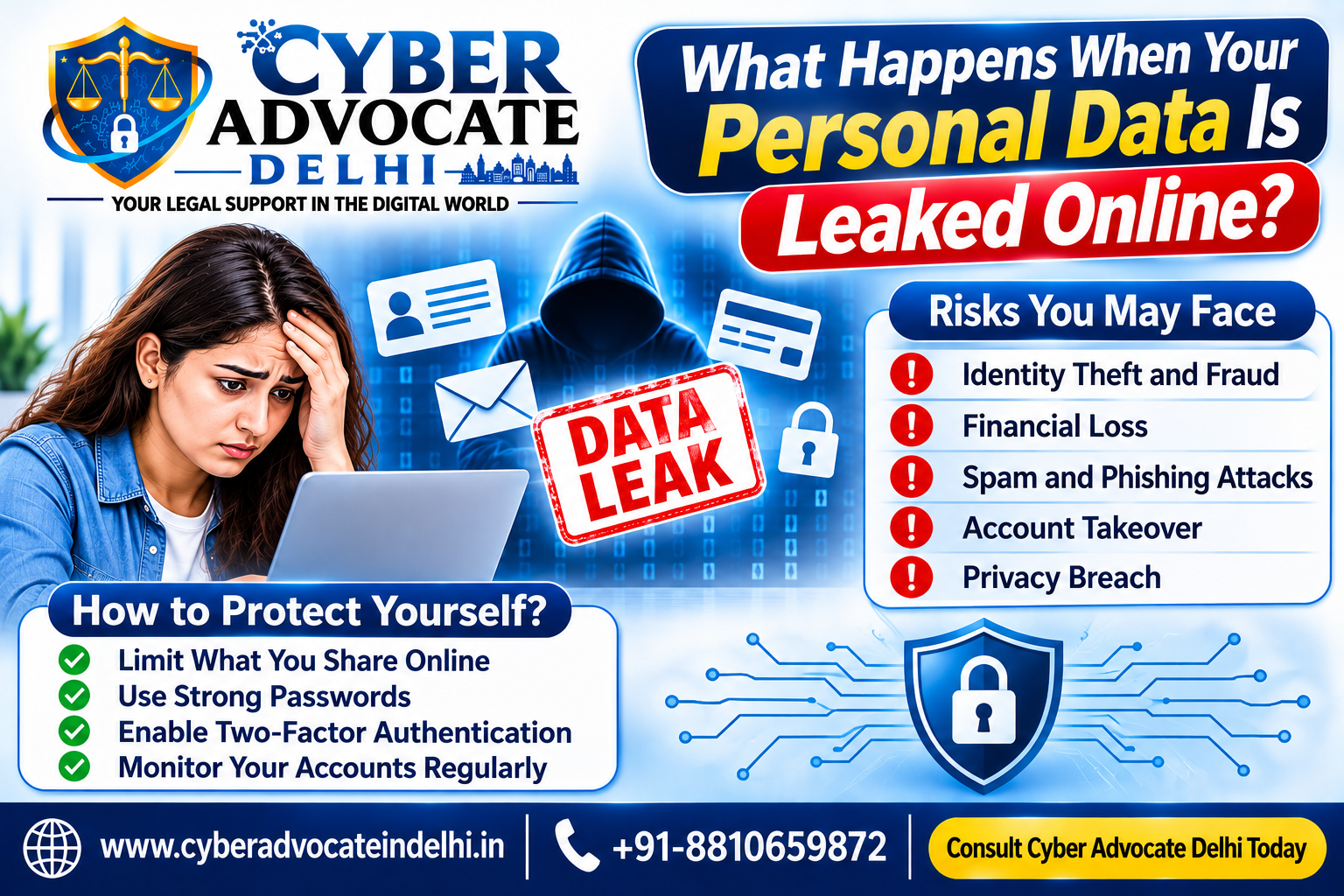
Personal data leaked online in Delhi? Learn what happens next, how to file a complaint and the legal remedies to remove your data and stop misuse.
It often begins with a strange phone call. A stranger knows your full name, your Aadhaar-linked mobile number, your loan amount or your home address in Delhi. Or a friend sends you a screenshot saying that your photographs and phone number are circulating in a Telegram group. This is a personal data leak, and it is more common than most people think.
The real worry is not the leak itself but what comes after it: scam calls, identity theft, blackmail and harassment. The good news is that Indian law gives you several legal remedies in Delhi, from police complaints to court orders for removal of the data. As advocates, we explain here what happens when your personal data is leaked online, and exactly what to do next.
What Counts as a Personal Data Leak and How It Happens
Personal data is any information that identifies you: name, phone number, email, address, Aadhaar or PAN details, bank and card information, photographs, health records, location and your online accounts. A personal data leak happens when this information reaches people who should not have it. The usual routes are:
- A company data breach: A bank, insurer, app, hospital or online store is hacked or careless, and customer records are exposed or sold.
- Insider leaks: An employee, agent or vendor sells or shares customer or staff data.
- Loan app and other app misuse: Apps that take contact and gallery permissions and later use them to threaten or shame you.
- Doxxing: Someone posts your home address, phone number or workplace online to harass or threaten you.
- Leaked images or documents: Private photographs, intimate content, ID scans or KYC documents shared without consent.
- Phishing and malware: You are tricked into entering details on a fake page or installing a harmful app.
- Data sold on Telegram, forums or the dark web, often in bulk, and later used for targeted scams.
Sometimes you will learn about it from a company’s notice. Often, you will learn about it only when the misuse begins.
What Can Happen After Your Data Is Leaked
What happens next depends on what was leaked, but the common consequences are:
- Targeted scam calls and messages, where the caller quotes real details to look genuine, for example posing as your bank, courier or a police officer.
- Identity theft: Fake SIM cards, loans, bank accounts or social media profiles opened in your name.
- Financial fraud: OTP and card fraud, account takeover, or fake investment and loan offers based on your details.
- Harassment and shaming, particularly where photographs, contacts or addresses are involved.
- Blackmail and extortion, including threats to release more private data unless you pay.
- Physical safety risks where a home address or daily routine is exposed.
- Reputation and job damage when sensitive or morphed content is shared with your employer or family.
Act early. The longer leaked data stays online, the more it spreads and the harder it is to remove.
Laws That Protect Your Personal Data
Several laws apply together. Which ones help you depends on how your data leaked and who is responsible.
| Law or rule | What it covers |
|---|---|
| Article 21 of the Constitution | The fundamental right to privacy, recognised by the Supreme Court in the Puttaswamy case |
| Digital Personal Data Protection Act, 2023 and Rules, 2025 | Duties of companies that hold your data, your rights to correction, erasure and grievance redressal, and the Data Protection Board. Rolled out in phases |
| IT Act, 2000, Sections 43 and 66 | Unauthorised access or copying of data, and the criminal version where it is done dishonestly |
| IT Act, Section 43A | Compensation where a company fails to protect sensitive personal data. Check what is in force on your date, as the new law is replacing it in stages |
| IT Act, Sections 66C, 66D and 66E | Identity theft, cheating by personation and violation of privacy |
| IT Act, Sections 72 and 72A | Breach of confidentiality and privacy, and disclosure of information in breach of a lawful contract |
| IT Act, Sections 67 and 67A | Publishing obscene or sexually explicit material |
| BNS Sections 78, 351 and 356 | Stalking, criminal intimidation and defamation |
| BNS Sections 318 and 319 | Cheating and cheating by personation, for fraud using leaked data |
| IT Rules, 2021 | Duties of platforms to publish a grievance officer, act on complaints and remove intimate or morphed content within 24 hours of a proper complaint |
| CERT-In Directions, 2022 | Companies must report specified cyber incidents, including data breaches, to CERT-In within six hours of noticing them |
The DPDP Rules were notified in November 2025 and are being brought in stages. The Data Protection Board was set up at the start, consent manager rules start around November 2026, and the main duties on companies, including breach notification and your rights as a data principal, start around May 2027. Until then, most remedies for a leak today come from the IT Act, the BNS, the IT Rules and civil courts.
What to Do in the First Hours
If you find that your personal data is leaked online, take these steps in order:
- Save the evidence first. Take screenshots with the date, the web address or group name visible, and save chats, call logs and the numbers used. Do not delete anything yet.
- Secure your accounts. Change passwords, turn on two-factor authentication and log out of unknown devices on email, banking, UPI and social media.
- Protect your money. If bank, card or UPI details are exposed, call your bank at once to block cards, reset PINs and watch for unusual transactions.
- Check for misuse of your identity. Look at your credit report for loans you did not take, and check your mobile connections for SIMs issued in your name through the telecom department’s portal.
- Do not pay or negotiate with blackmailers. Payment rarely ends the threat and often makes it worse.
- Tell trusted people. If contacts may receive messages, warn family and colleagues briefly that any message about you from a stranger may be a scam.
- Note the source. If a company sent a breach notice, keep it. If an app or employer may be the source, write down the dates and what you shared.
Your advocate can then prepare a certificate for electronic evidence under Section 63 of the Bharatiya Sakshya Adhiniyam, 2023, so that the screenshots stand up in court.
Cyber Crime Complaint in Delhi, Step by Step
A cyber crime complaint in Delhi for a data leak can be made in several places:
- Helpline 1930 and cybercrime.gov.in. Use these at once if money was lost, or if there is blackmail, morphed images or impersonation. For sexual or intimate content, choose the women and child related category on the portal. Keep the acknowledgement number.
- Delhi Police cyber units. Delhi has a Cyber Police Station in each police district, and the IFSO unit handles larger and complex cyber cases. Any police station can also register a cyber complaint.
- FIR. Where a cognizable offence such as extortion, stalking or identity fraud is made out, you can ask for an FIR naming the relevant sections of the BNS and IT Act.
- Complaint to the company. If a bank, app, insurer or employer leaked your data, write to its grievance officer or data protection contact, state what happened, and ask what it will do. Keep the reply.
- Sector regulators. For a bank or NBFC, complain through RBI’s channels. For insurance, brokers or listed companies, the relevant regulator also has a complaint system.
- Platform reports. Report the post, group or profile to the platform using its privacy or non-consensual content tools, and ask the platform’s grievance officer to act under the IT Rules.
- Data Protection Board. The Board has been set up under the DPDP Act, but its complaint process for data principals depends on the stage of the rules coming into force. Take advice on whether it is open for your case.
If the police do not act, send a written complaint to the senior police officer of the district and, if needed, approach the Magistrate under the Bharatiya Nagarik Suraksha Sanhita, 2023.
Legal Remedies Available in Delhi
The legal remedies in Delhi for leaked personal data work on several tracks together:
- Criminal case: An FIR against the people who leaked, sold or misused your data, under the IT Act and BNS sections that match your facts.
- Urgent court orders in the Delhi High Court: The court can order platforms to remove data and content, and to disclose who uploaded it. It has passed orders against unknown persons (John Doe orders), for example to stop the publication of leaked customer data in a ransomware extortion case in 2024 and 2025, and to remove doxxing and deepfake content on privacy grounds in 2026.
- Takedown through the IT Rules: A written complaint to the platform’s grievance officer, and an escalation to the government grievance appellate committee if the platform does not act.
- De-indexing and removal: Requests to search engines and websites to remove the web addresses carrying your data, backed by a court order in tougher cases.
- Compensation: A civil claim for damages against the company that failed to protect your data, or against the person who misused it, for loss, distress and reputation damage.
- Action against the data holder: A complaint to the company’s grievance officer, the sector regulator, and, as the DPDP regime comes into force, the Data Protection Board, which can impose heavy penalties on companies that fail to protect data.
- Freezing and recovery: Where money was taken using leaked data, the police and banks can freeze funds if you act quickly.
- Legal notice: A notice from an advocate to the company, platform or individual, demanding removal, disclosure of the breach and compensation.
Which route fits depends on who leaked the data and how fast it is spreading. In urgent cases we usually combine a police complaint, takedown notices and a High Court application.
How to Protect Yourself From Data Misuse
You cannot stop every breach, but a few habits limit the damage. Our advice as a cyber advocate in Delhi:
- Share only what is needed. Do not give Aadhaar, PAN or copies of ID to unknown apps, shops or websites, and mask your Aadhaar where possible.
- Check app permissions. Deny contacts, gallery and location access to loan and utility apps that do not need them.
- Use unique passwords and two-factor authentication, and a password manager if you can.
- Set up alerts for bank, card and UPI transactions, and check your credit report regularly.
- Freeze or lock what you can: lock your Aadhaar biometrics where available, and keep social media profiles private.
- Be careful with documents: write the purpose and date on any ID copy you hand over, for example “for SIM purchase only”.
- Never share OTPs or screen-sharing access, even with someone who quotes your real details.
- Know your rights as the DPDP rules come in: you will be able to ask companies what data they hold, to correct or erase it, and to complain about a breach.
- Keep a one-page action plan with your bank helpline, 1930 and an advocate’s contact.
A few minutes of care now is far easier than clearing up a leak later.
Common Mistakes and Questions
These mistakes most often make a personal data leak harder to handle:
- Deleting the evidence in panic, or blocking numbers before saving them.
- Paying a blackmailer or a “data removal agent”.
- Clicking on links sent in the name of the company that leaked your data, which are often fresh scams.
- Waiting for the company to act, instead of securing your own accounts first.
- Sharing your OTP or card details with someone who already “knows” your information.
Can I get my leaked data removed from the internet? Often you can get it removed from specific pages and platforms through takedown requests and, where needed, a court order. Removing every copy from the internet is not always possible, which is why early action matters.
Is the company liable if it leaked my data? It may be. A company has duties to protect personal data, and a failure can lead to a complaint to regulators, a claim for compensation and penalties under the data protection law as it comes into force.
Do I have to be a victim of fraud before I complain? No. You can complain about a leak and its misuse, including threats and impersonation, even before you have lost any money.
What if the person leaking my data is unknown or abroad? Delhi courts have passed orders against unknown persons and directed platforms to disclose account details. Tracing and action against people abroad is harder and depends on the case.
Should I go to the police or the court? Often both. The police complaint helps trace the people and money, while an application in the High Court is usually faster at getting content removed.
Contact Us
If your personal data is leaked online and you need guidance on your legal remedies in Delhi, you can reach us here:
- Website: https://cyberadvocateindelhi.in/
- Helpline: +91-8810659872
Disclaimer
This blog is published for educational and informational purposes only. It is not an advertisement or solicitation, and it is not a substitute for legal advice on your specific facts.
